“It occurred to Thadred that perhaps the kelpie had seen into him the same way that he had seen into it. What would that have meant? How would an animal brain even begin to understand the complexities of human life?” (Wheatley 318)
It’s in the quiet, unsuspecting moments in reading when sentences like these stop you in your tracks and force you to reflect on the depth of what is being said – long after you’ve finished the final page.
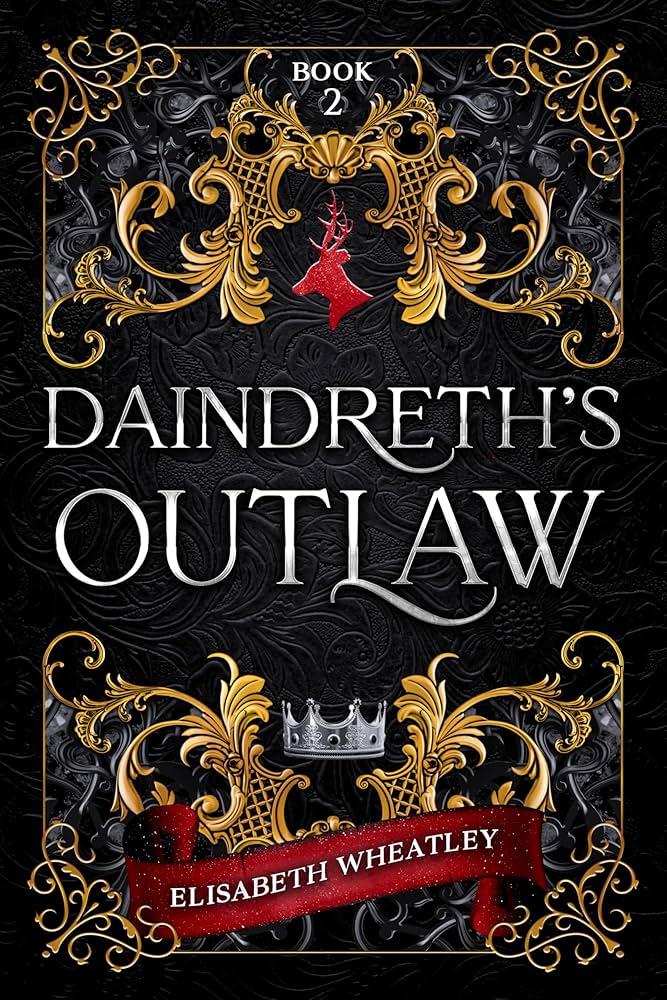
Daindreth’s Outlaw by Elisabeth Wheatley is the second installment in her fantasy romance series, following Amira, a sorceress, and her betrothed, Daindreth, the archduke. The sequel finds the pair, along with Thadred, the archduke’s cousin, on a dangerous journey to break the hidden curse that Daindreth carries.
Wheatley dives deeper into her characters throughout the sequel, telling the story through the perspectives of Amira, Daindreth, and Thadred. The world itself is also depicted in greater depth, with readers learning more about the Cursewood – the land of the north created by the Istovari sorceresses – as well as the beings that inhabit it. In addition, readers are introduced to new characters, such as Sairydwen, a character I personally loved very quickly.
The darkness of the Cursewood reminded me strongly of the nightmarishness of today’s world. Yet Wheatley consistently challenges her readers through moments and lines that seem simple and easy to overlook. When examined more closely, these moments invite readers to grow alongside the characters themselves.
“Is something right because the majority approves it?” (Wheatley 119)
How often do people in society go along with the flow, acting in ways that conflict with what they truly believe simply to fit in? History has shown us, again and again, that consensus is not synonymous with truth. Progress often begins with a minority – sometimes a single voice – willing to question what everyone else has accepted as normal. In Daindreth’s Outlaw, Wheatley reinforces this idea by placing her characters in situations where integrity demands isolation rather than approval.
The hardest moments are not when the right path is unclear, but when choosing it means standing alone.
To stand apart requires the same vulnerability as being seen. It means risking misunderstanding, criticism, and isolation, but it also means honoring an internal compass rather than outsourcing values to the crowd. In this way, Wheatley challenges her readers to reflect on integrity and its value in their own lives.
Later in the novel, Wheatley returns to this idea of being truly seen through Thadred’s encounter with the kelpie. What initially appears to be an impossible, even philosophical question becomes an invitation to live with empathy. Having worked in healthcare for more than a decade, I am no stranger to the Cleveland Clinic’s well-known video about empathy – and I highly encourage anyone who hasn’t seen it to seek it out. One of the greatest challenges in life is the lack of genuine empathy and compassion.
Through the presence of a dangerous and misunderstood creature, Wheatley encourages readers to pause, to truly see others, and to allow themselves to be seen in return. It is through this vulnerability and empathy that we learn from one another, grow, and form deeper connections.
Ultimately, Daindreth’s Outlaw is more than a fantasy romance or a continuation of an already compelling story – it is a thoughtful exploration of what it means to live with courage, integrity, and empathy in a complex world. Through moments of moral tension and quiet reflection alike, Wheatley reminds readers that being truly seen is both frightening and transformative, and that doing what is right is not always what is easy. In a world that too often rewards conformity and overlooks compassion, Daindreth’s Outlaw offers a hopeful reminder that growth begins with vulnerability, and that meaningful change – both in stories and in life – starts when we choose to see one another fully.
 Well-Lived, Well-Read
Leave a comment