“Never believe you are helpless. Always choose how you act.” (Wheatley 216)
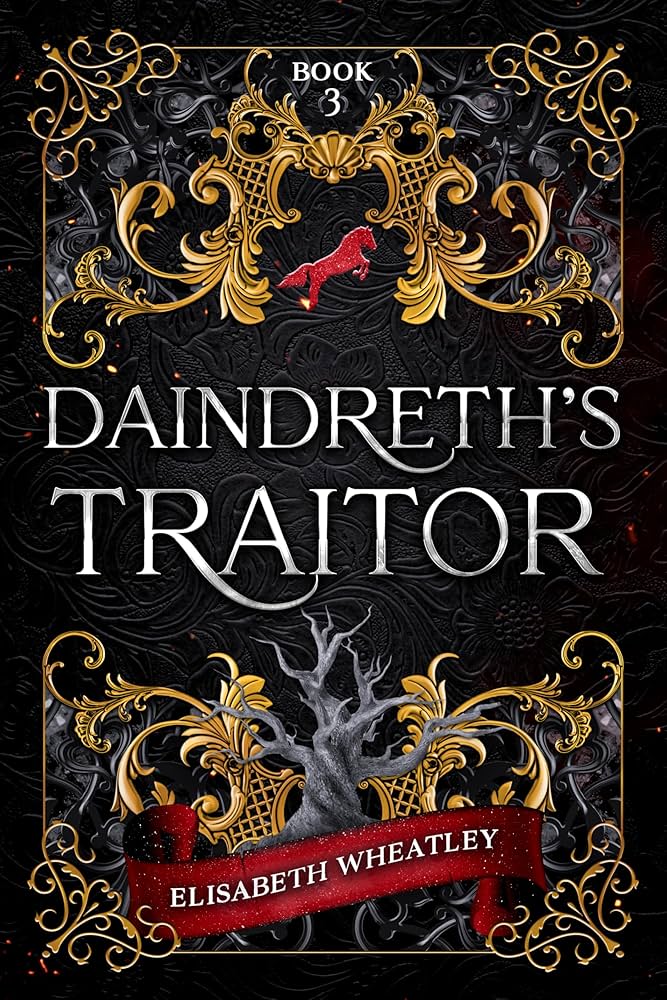
Long after finishing the final pages of Daindreth’s Traitor, the story’s central message lingered with me—quietly persistent, yet deeply powerful. Daindreth’s Traitor, the third installment in the Daindreth’s Assassin series by Elisabeth Wheatley, begins immediately where Daindreth’s Outlaw ends, launching readers into a high-stakes race to break Daindreth’s curse. For readers who enjoy morally complex fantasy grounded in character-driven storytelling, the novel is a compelling and emotionally resonant continuation of the series.
Captured by the Istovari, a clan determined to avenge the actions of Daindreth’s father, Amira and Daindreth are forced to navigate distrust, political tension, and cultural hostility while time runs out. As Empress Vesha and the Imperial Army rapidly close in, survival depends not only on strength, but on the fragile act of earning trust. Despite its relentless pacing, the novel preserves the rich world-building and layered character development that define Wheatley’s writing. Readers are introduced more fully to the Cursewood, a place of constant change and uncertainty—one that feels uncomfortably familiar.
“‘Nothing is straightforward in this place, is it?’” (Wheatley 182)
That sentiment extends far beyond the Cursewood. The novel repeatedly emphasizes that the world—both fictional and real—is not divided neatly into good and evil. Motives are tangled, choices are constrained, and fear often drives people to act against their own values. As the text observes, “But he knew as well as anyone that it didn’t take evil men to do evil things” (Wheatley 82), and “‘Good men do as much evil as bad men’” (Wheatley 96). Fear, in particular, distorts judgment: “‘And frightened people do the stupidest things’” (Wheatley 100).
How often do we, as readers—or as people—attempt to categorize others as wholly good or wholly evil without understanding the circumstances that shaped their decisions? Daindreth’s Traitor challenges this instinct, reminding us that ordinary individuals are capable of harm not because they are inherently cruel, but because they are navigating fear, confusion, and impossible choices. Yet, crucially, the novel never relinquishes the importance of agency. Even in a morally gray world where nothing is straightforward, individuals are not truly helpless. They may not control their circumstances, but they can always choose how they respond—and in those choices lies both responsibility and hope.
 Well-Lived, Well-Read
Leave a comment